

October 9, 2026
Instantly pricing · the contact cap that never resets
Instantly's Growth plan holds 1,000 contacts in total, and the count never refills. Here's how the lifetime cap and 2-month credits shape your bill, and when Smartlead comes out cheaper.
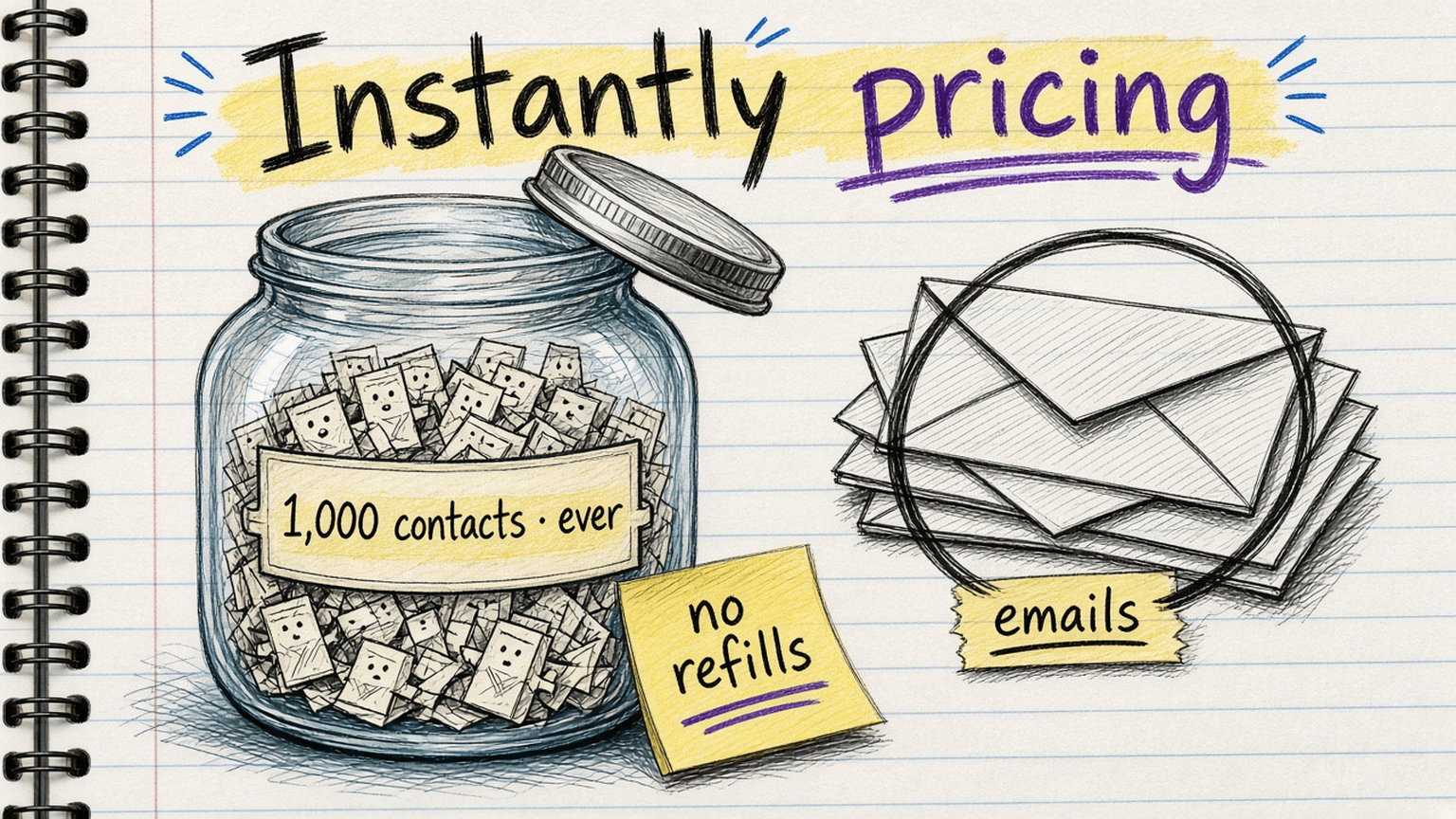
Say you pick Instantly's Growth plan at $47 a month. The plan card says 5,000 emails a month. For a first cold campaign, that sounds like plenty.
Instantly is a sequencer. A sequencer is the tool that sends your email steps over several days.
You load 1,000 people. Each one gets 3 emails.
The math: 1,000 people × 3 emails = 3,000 emails. That's 2,000 fewer than the 5,000 you pay for.
Next month you go to add 1,000 new people. Instantly asks you to upgrade.
Aditya, replying on X to a post about sending 10,000 cold messages, put it in one line.
you'll have to use the 97/mo plan on instantly cause 47/mo only allows 1000 uploaded contacts.
Instantly sells you emails. It charges you for people.
The 1,000 that never refills
An uploaded contact is one person you've added to a campaign. Each Instantly plan has a limit on them.
Growth holds 1,000. Hypergrowth, at $97 a month, holds 25,000. Light Speed, at $358 a month, holds 100,000.
They're easy to read as monthly numbers. Instantly's own help page says otherwise.
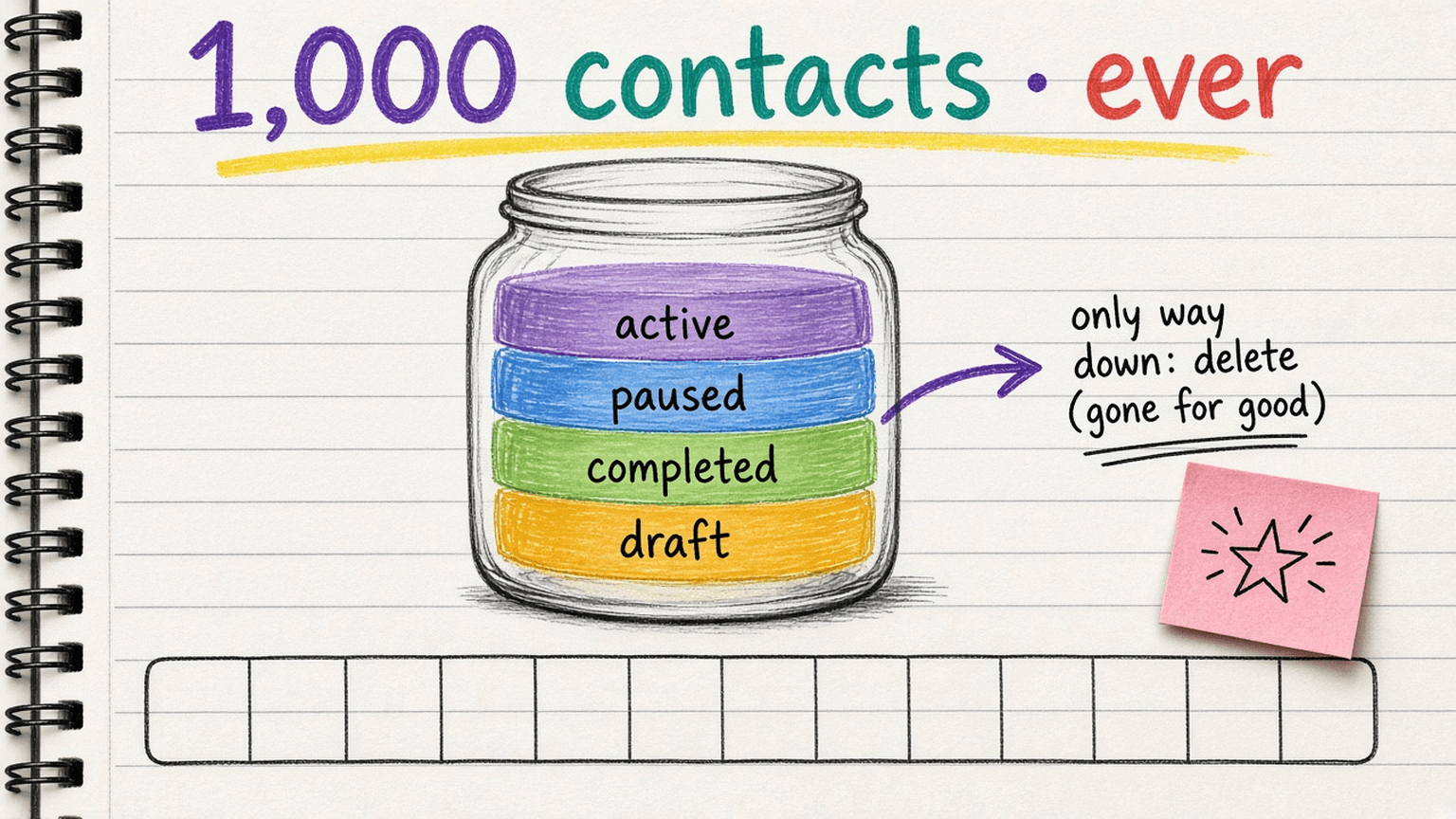
It calls the limit a "fixed total, not a monthly allowance." It counts every lead you've ever put into a campaign. That includes active, paused, completed and draft campaigns.
So a campaign that ended in March still takes up room in October.
The math: 1,000 new people in month one fills Growth. Month two has room for 0 new people.
One contact too many costs $50
Many tools charge an overage. An overage is a small fee for going a little past your limit.
Instantly doesn't. Its own pricing notes say you "upgrade tiers rather than pay an overage charge."
The math: contact number 1,001 on Growth moves you from $47 to $97. That's $50 more a month for one person.
The same rule holds higher up. Fill Hypergrowth's 25,000 and the next plan on the pricing page is Light Speed at $358.
Instantly's own pricing notes list one more option on Hypergrowth and up. An add-on at $87 a month gives you 25,000 more contacts and 125,000 more emails.
The free fix deletes your history
You can make room without paying. You delete old leads or old campaigns.
The help page lists the catches. Removing someone from a list doesn't help. They have to leave the campaign. Deleted leads can't be brought back. Deleting also doesn't give back any credits you spent on them.
Instantly doesn't delete anything for you. You do it.
Think about what leaves with those leads. You lose the record of who replied and who asked you to stop. That record is what keeps you from emailing the same "no" twice.
So the free fix is really a choice about keeping your history.
The people count matters more than the email count
Instantly gives you 5 emails for every contact, on every plan.
The math: Growth is 5,000 emails ÷ 1,000 contacts = 5. Hypergrowth is 125,000 ÷ 25,000 = 5. Light Speed is 500,000 ÷ 100,000 = 5.
Smartlead, another sequencer, gives 3. Base is 6,000 sends for 2,000 contacts. Pro is 90,000 sends for 30,000 contacts. Three emails is a 3-step sequence.
Most teams don't send 5 emails to everyone. So on Instantly, the email allowance usually runs out last. The contact limit runs out first.
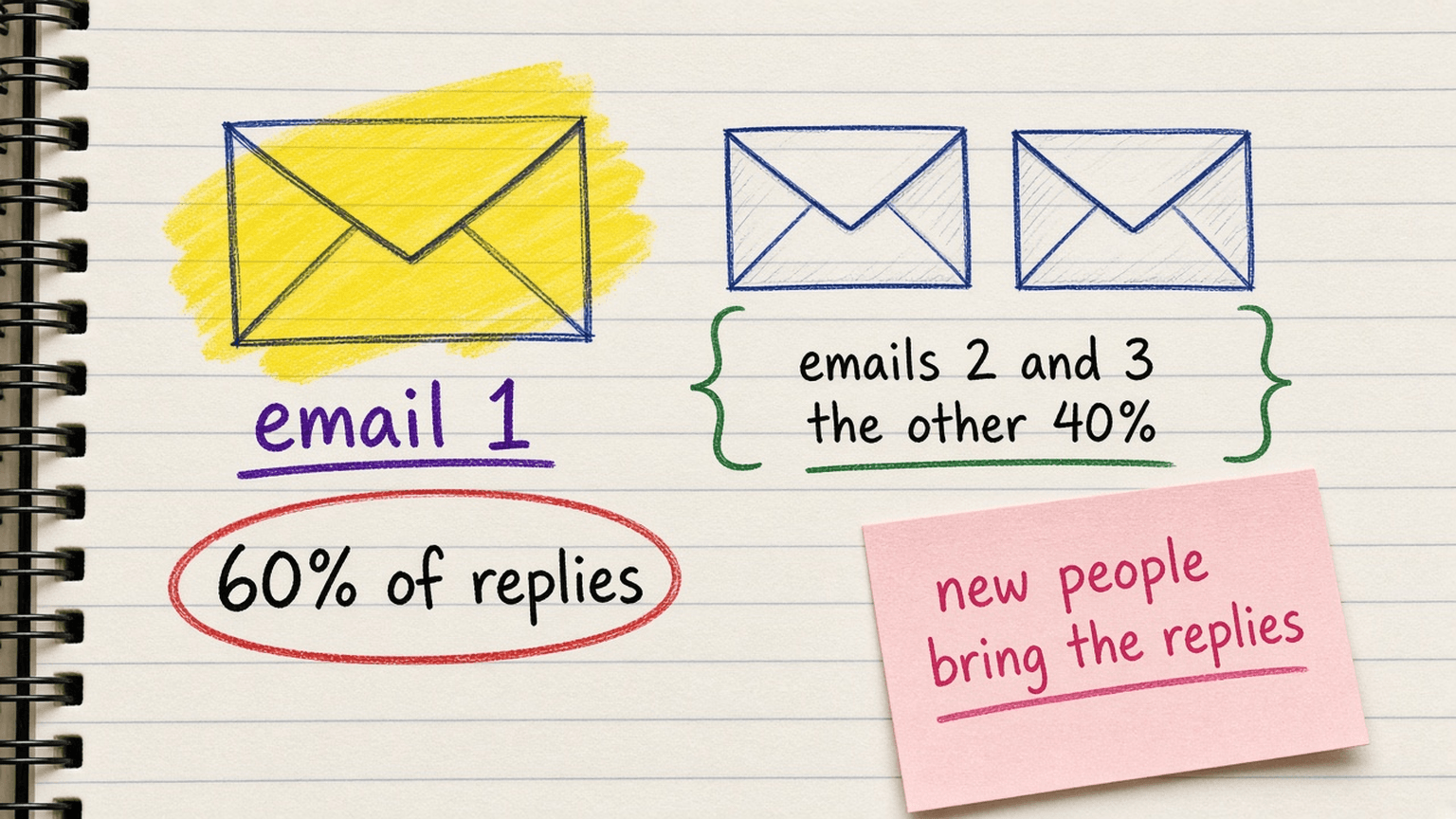
Newlead is an outbound agency that publishes its client results. Its 2026 report, updated October 5, includes one big campaign to finance companies in the US and Canada. It sent about 117,000 emails across 3 steps. The first email brought in 60% of all human replies. Emails two and three brought in the other 40%.
That's one agency's campaign on its own setup. Treat it as a baseline. It still points one way. Most replies come from reaching new people. Extra emails to the same people bring fewer.
Newlead's US clients averaged a 1.66% reply rate.
The math: 1,000 contacts × 1.66% = about 17 replies. On Growth, that's about 17 replies in total until you delete.
Keep everything or delete every month
Here's a test case. A team adds 2,500 new people a month. Each person gets a 3-step sequence, so that's 7,500 emails a month.
Both tools start in the same place. Instantly needs Hypergrowth at $97. Smartlead needs Pro at $94.
First, say the team never deletes.
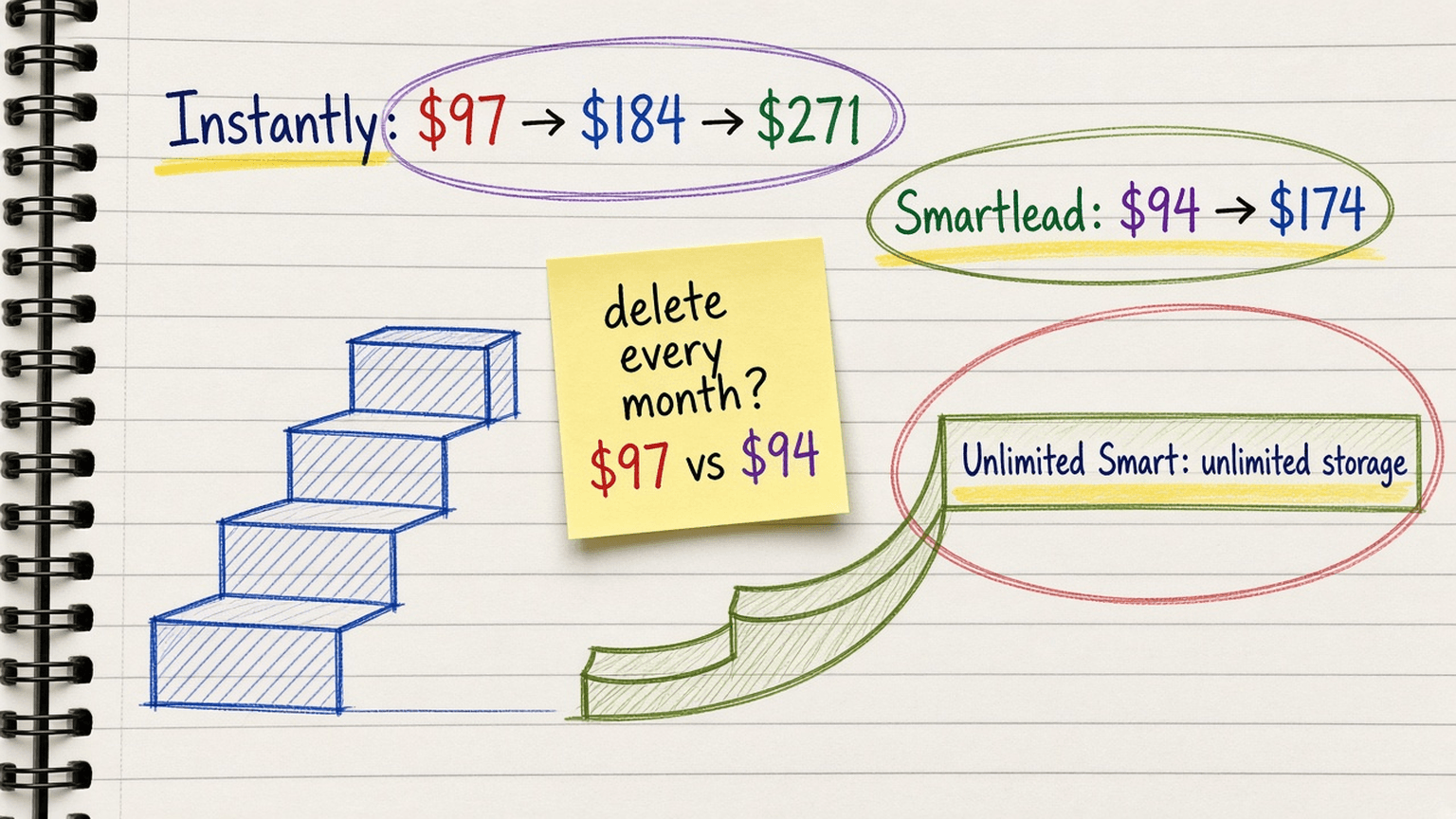
The math on Instantly: 2,500 a month fills Hypergrowth's 25,000 in month 10. From month 11 the team adds the $87 add-on, so the bill is $184. Year one is 10 × $97 + 2 × $184 = $1,338.
The math on Smartlead: Pro holds 30,000, so it fills in month 12. Year one is 12 × $94 = $1,128.
In month 13 the Smartlead team moves to Unlimited Smart at $174. That plan has unlimited contact storage. Storage means the people you keep in the tool. Smartlead's own words are that you "don't have to delete your leads."
The math: by month 24 the team has 60,000 stored people. Instantly is $97 + 2 × $87 = $271 a month. Smartlead Unlimited Smart stays at $174. At 100,000 people, Instantly's Light Speed plan is $358 against $174. Past 100,000, Instantly's next step is Enterprise, which is a custom quote.
Now say the team deletes finished campaigns every month.
Instantly stays on Hypergrowth at $97. Smartlead stays on Pro at $94. The math: $97 minus $94 is $3 a month. A gap that small decides nothing.
If you delete old leads every month, the bills come out almost the same. Smartlead only pulls ahead when you keep your history.
Credits run on a second clock
Instantly also sells credits. A credit is the unit Instantly charges for extra jobs like finding leads and writing AI replies.
Credits are a separate plan from sending, and they have their own clock.
Instantly's own pricing notes say unused credits expire 2 months after you buy them on a monthly plan. On a yearly plan they last 1 year.
The math: credits bought on March 1 on a monthly plan are gone by May 1 if you don't use them.
An AI reply costs 5 credits. Finding a work email costs about 1.5.
If you buy only a credits plan with no sending plan, you can upload just 250 leads to campaigns.
Features shift by plan too. On Growth, the Unibox, Instantly's shared reply inbox, is preview only. Webhooks, which pass events to your other tools, start on Hypergrowth.
Last, check the pricing page the day you buy. Instantly's own numbers don't always match. The Hypergrowth card says 125,000 emails. The compare table on the same page says 100,000.

What to do
Count the people you'll email in a year. Then pick the plan.
- You keep every lead and add thousands a month. Use Smartlead. Pro is $94 for 30,000 stored contacts. Unlimited Smart is $174 with unlimited storage and 150,000 sends a month.
- You're small and just starting. Smartlead Base is $39 for 2,000 contacts and 6,000 sends a month.
- You run campaigns for clients. Smartlead adds white-label from Pro at $29 per client. White-label means your client sees your brand on the tool.
- You already delete old campaigns every month. The bills are close. Pick the tool your team works fastest in.
If you keep your history, Smartlead is the cheaper place to keep it.
Next · Smartlead vs Instantly puts the two side by side · Smartlead pricing shows what Smartlead's add-ons cost · Instantly alternatives lists more cold email tools.